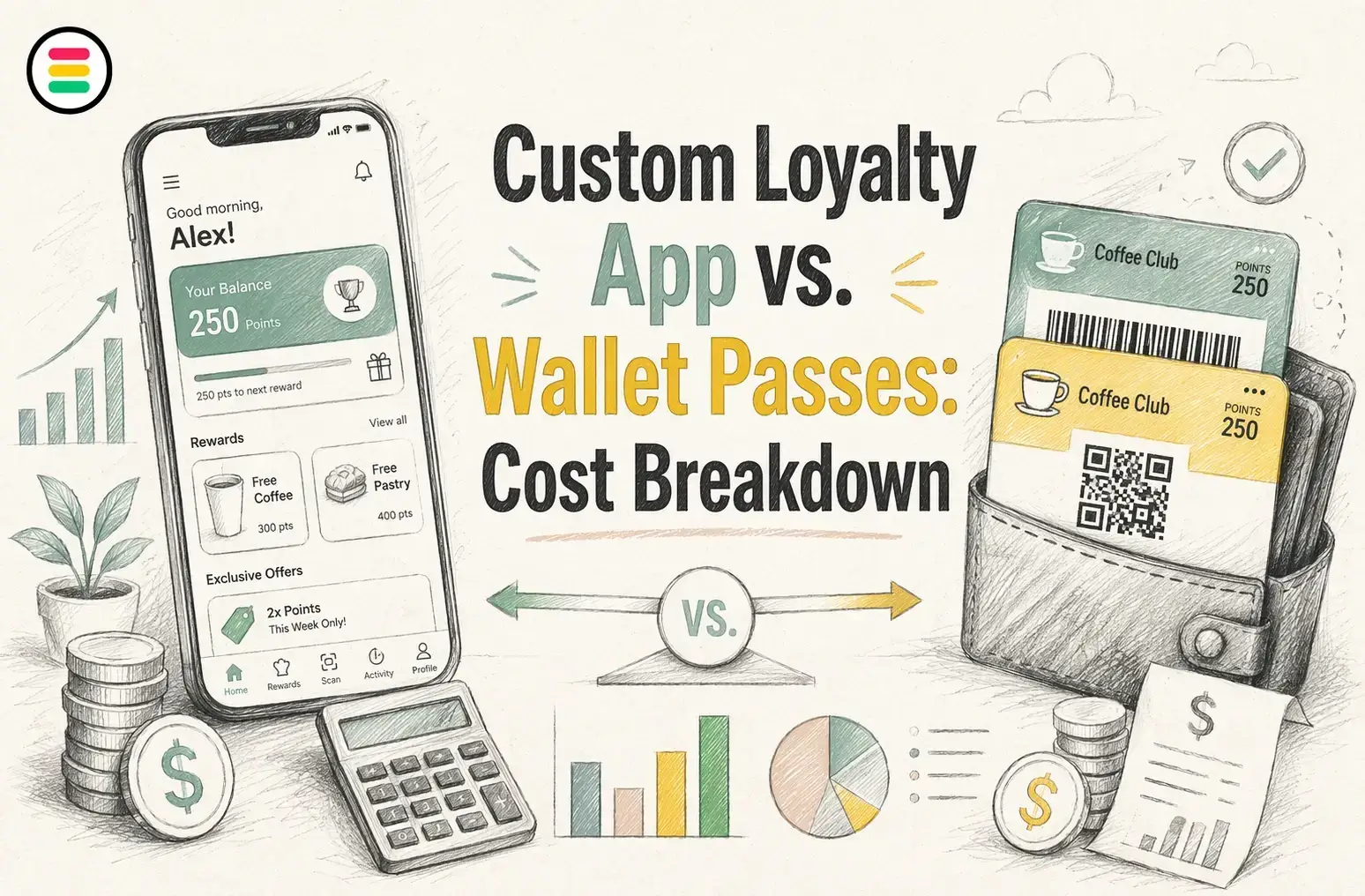
Quick Summary: Small businesses usually save money and launch faster with wallet passes instead of custom loyalty apps. Custom apps cost more upfront and ongoing, especially with development and maintenance, while wallet passes are simpler and quicker to deploy. Wallet passes reduce launch delays and operational overhead, making them ideal for quick rollouts and casual customers. Choose a custom app only if your loyalty program requires complex features or deep data integration.
For most small businesses, wallet passes cost less and launch faster. A custom app usually makes sense only when your team needs unique workflows, deep integrations, or full control of the product. Many owners and multi-location teams now weigh bespoke apps against Apple and Google wallet options, so Loyalty App Cost, Loyalty Program Cost, and this Wallet Passes Comparison matter more than feature lists.
This guide uses real-world cost logic from loyalty planning, vendor reviews, and rollout work across retail, food service, beauty, fitness, and hospitality. You will see Loyalty App Cost, Loyalty Program Cost, Reward Program Cost, and Loyalty System Cost side by side in a practical Wallet Passes Comparison, Reward App Comparison, and Wallet Passes Comparison for Digital Loyalty Cards, Loyalty Wallet Passes, Customer Loyalty Software, and key Loyalty App Benefits.
| Custom loyalty app | Wallet passes | |
|---|---|---|
| Upfront cost | High; usually requires substantial development and design investment | Low to moderate; typically far less than custom app development |
| Ongoing cost | High; hosting, updates, bug fixes, and feature work | Low to moderate; subscription or usage-based platform fees |
| Time to launch | Slow; typically requires a longer build and test cycle | Fast; often days or weeks |
| Maintenance burden | High; app store updates and ongoing technical support | Low; platform handles most updates and infrastructure |
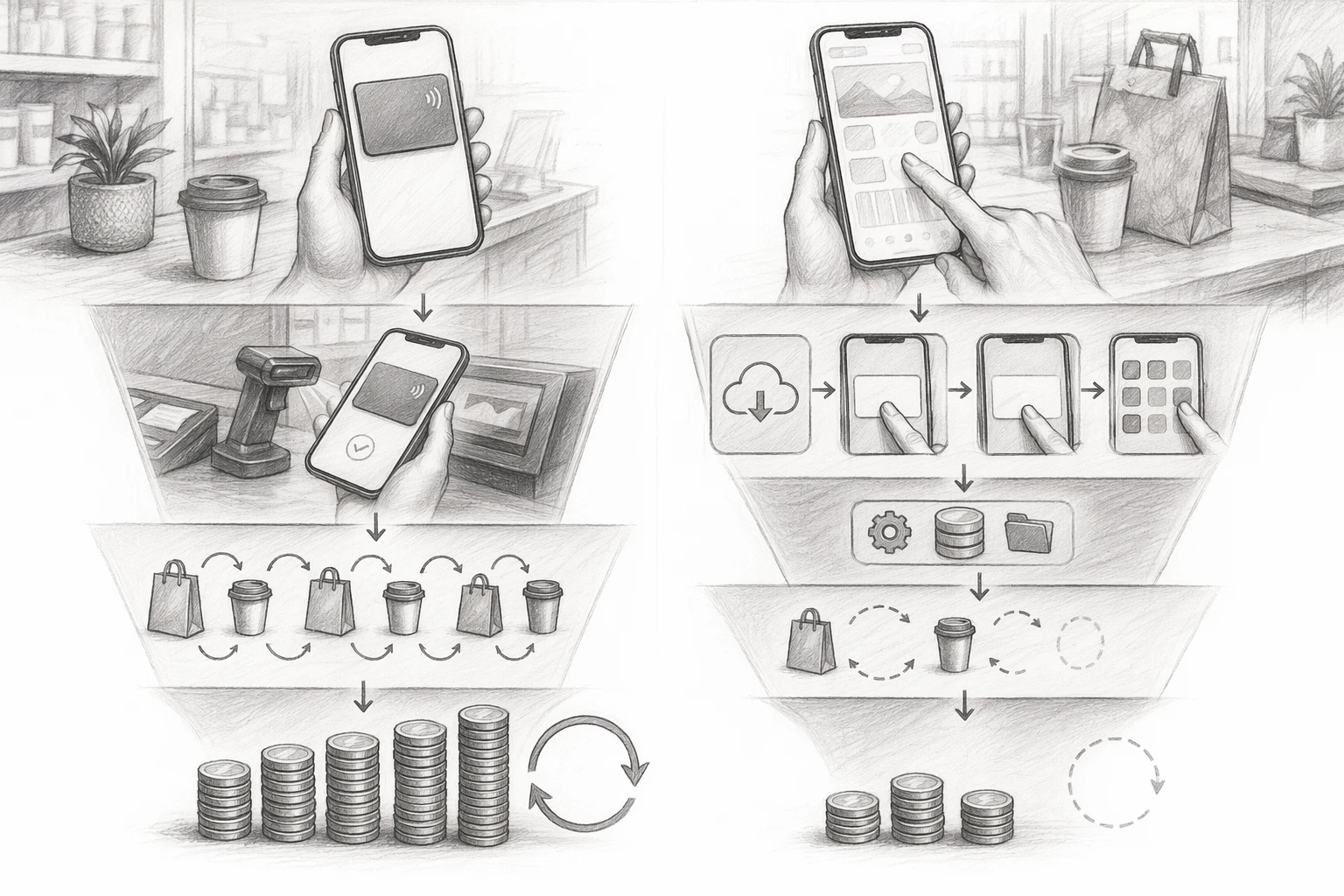
| Customer experience | Requires download, signup, and app adoption | No app download; customers add the pass to their phone wallet |
| Best fit | Enterprise or highly specialized loyalty programs | Small businesses and multi-location operators |
A custom loyalty app is built for one brand, with full control over features, design, and data. It fits larger operators with complex needs, but Loyalty App Cost and total Loyalty Program Cost are usually highest because build, testing, and upkeep all stack up.
 Key strengths
Wallet passes are digital loyalty cards saved in Apple Wallet or Google Wallet, with no app download. They fit small businesses and multi-location teams that want lower Loyalty App Cost and a faster, simpler Loyalty Program Cost path, using wallet features Apple supports in its loyalty pass docs.
Key strengths
A custom loyalty app usually burns cash upfront. You pay for UX, iOS and Android builds, backend work, QA, analytics, release cycles, and ongoing updates. A 2026 market estimate from Business of Apps puts simple apps at $5,000 to $50,000, with more complex builds rising far above that. Wallet passes shift spend into a lower monthly operating cost instead. You still need setup, branding, and pass logic, but not a full consumer app stack.

Hidden costs are where buyers get caught. Apple Wallet passes need signing, distribution, and update support, while Google Wallet passes still follow a multi-step issuer and object flow through the Google Wallet pass development flow. That is lighter than a full app, but it still takes time and technical oversight.
The cheapest quote is rarely the lowest total cost. Check who owns setup, updates, support, and reporting before you buy.
A slow launch costs more than the build itself. If your custom app sits in design, testing, or store review, your staff still spends time training, fixing bugs, and answering customer questions. That delay also pushes back reward signups, repeat visits, and first-party data collection.
According to Wikipedia's summary of Apple's review process, App Store approval rules can change and rejected apps often need fixes and resubmission. In 2026, even "normal" review windows can stretch when queues spike, with reported delays reaching well beyond standard timelines.
| Launch issue | Cost impact |
|---|---|
| App review delay | Missed campaign dates |
| Bug fixes before approval | Extra dev hours |
| Resubmission cycle | More staff time |
| Customer wait time | Lower early adoption |

Every extra week before launch increases the chance that your promo calendar, store team, and customer interest drift out of sync.
Wallet passes cut out the biggest bottlenecks. You do not need a full app build, app store listing, or long approval cycle. That makes rollout simpler across retail, food service, fitness, and multi-location teams.
For operators who need speed, wallet passes often turn loyalty into an operations win, not a software project. That is where platforms like OneCup can make more sense than a custom app.
A custom loyalty app keeps billing you after day one. You still need OS updates, bug fixes, SDK changes, store listing work, analytics checks, and support for login, payments, and account recovery. Apple also requires passes and updates to rely on your server and certificates, which means more backend upkeep if you build deep wallet-like features into your own stack Apple's update service docs.
Common ongoing costs include:
The real risk is not launch cost. It is paying every month to keep the app stable, approved, and current.
Wallet passes still need setup, but the operating model is lighter. You update the pass, not a full app experience. Apple Wallet supports real-time pass updates through Wallet, while Google Wallet lets you patch objects and even expire passes automatically up to 24 hours after the valid end time Google's pass update guidance.
That usually means less overhead:
For small teams, platforms like OneCup make this simpler because staff manage loyalty without carrying full mobile app overhead.
Why lower friction usually means higher enrollment
Customers join loyalty programs when the signup feels easy. A wallet pass cuts out the biggest drop-off point: the app download. That matters because many apps get deleted fast. In the U.S., Android apps saw a 48.02% uninstall rate within 30 days in 2024, according to Statista data. If half your audience disappears that quickly, your cost per active member climbs fast.
If your main goal is enrollment across many casual buyers, fewer steps usually beat more features.
When a custom app can still justify the spend
A custom app can still pay off if it does more than loyalty. It needs to drive real revenue through features like ordering, booking, subscriptions, or account management. Otherwise, you may spend heavily to reach a small active base. Wallet pass platforms also keep improving measurement, with operators tracking save rate, repeat usage, and redemption over time through mobile wallet analytics.
Use a custom app when you need:
For most small and mid-sized operators, wallet-first programs often produce better ROI per dollar spent. That is where app-free options like OneCup fit well.
Choose wallet passes if you want the lowest setup cost and the fastest path to launch. They work well for cafés, salons, gyms, quick-service brands, and multi-location shops that need simple rewards without building and maintaining an app. Apple says passes can be shared through SMS, email, web, QR codes, and even App Clips, which keeps signup friction low Apple Wallet loyalty passes. Google also supports loyalty cards across web, email, and SMS, so you can reach customers without asking for an app download Google Wallet loyalty cards.
If your main goal is repeat visits, wallet passes usually give you the best cost-to-speed ratio.
Choose a custom loyalty app if your program needs deeper control. An app makes more sense when loyalty is tied to ordering, booking, memberships, referrals, or rich customer profiles. It also fits brands that need custom UX, complex rules, and more first-party data. That extra control costs more because you pay for design, development, updates, app store work, and user support.
Use this simple rule:
| Need | Better fit |
|---|---|
| Fast launch, lower spend, easy adoption | Wallet passes |
| Deep features, custom flows, full brand control | Custom app |
Custom apps cost far more upfront because you pay for design, build, testing, store launch, and updates. Wallet passes usually have lower setup fees and lower monthly costs.
Custom app costs change a lot by region because developer rates vary. Wallet passes stay more predictable worldwide since setup is simpler and needs less custom work.
Main cost drivers include features, POS links, CRM sync, branding depth, user login, push tools, analytics, support, and compliance needs. More custom work always raises app cost.
Yes, in most cases. Small businesses usually get faster payback from wallet passes because launch costs stay low, staff training is easier, and customers do not need another app.
A custom app can drive more spend if customers use it often. Wallet passes often win on adoption, which can lead to better real-world retention for less money.
Labor, compliance, payment tools, and support costs shift by country. Multi-location brands also face local setup needs, while wallet pass programs like OneCup often scale with less regional friction.
Watch for app store fees, bug fixes, security work, version updates, vendor management, and low adoption after launch. These costs often push total ownership much higher than expected.
Start with your adoption goal, not feature wish lists. Pick the option that staff can run well, customers will actually use, and your budget can support for years.
Custom loyalty apps make sense when you need deep features, complex flows, or tight brand control. Wallet passes win when you want lower setup cost, faster launch, and less customer friction. The real choice is not sticker price. It is total cost of ownership, staff time, adoption risk, and ongoing support. That matters more as wallet use grows. In 2026, 31% of consumers used a mobile wallet in-store in the last seven days, according to PYMNTS. Apple is also expanding loyalty and rewards pass features in Wallet, based on Digital Trends' WWDC 2026 coverage.
If you want the simplicity of wallet passes without building anything custom, OneCup offers app-free digital loyalty cards with transparent, predictable pricing. Get started with OneCup and see how simple digital loyalty can be.
OneCup LLC
651 N BROAD ST - SUITE 201
MIDDLETOWN DE 19709
United States
Whatsapp : +18023003737

.svg)

.svg)