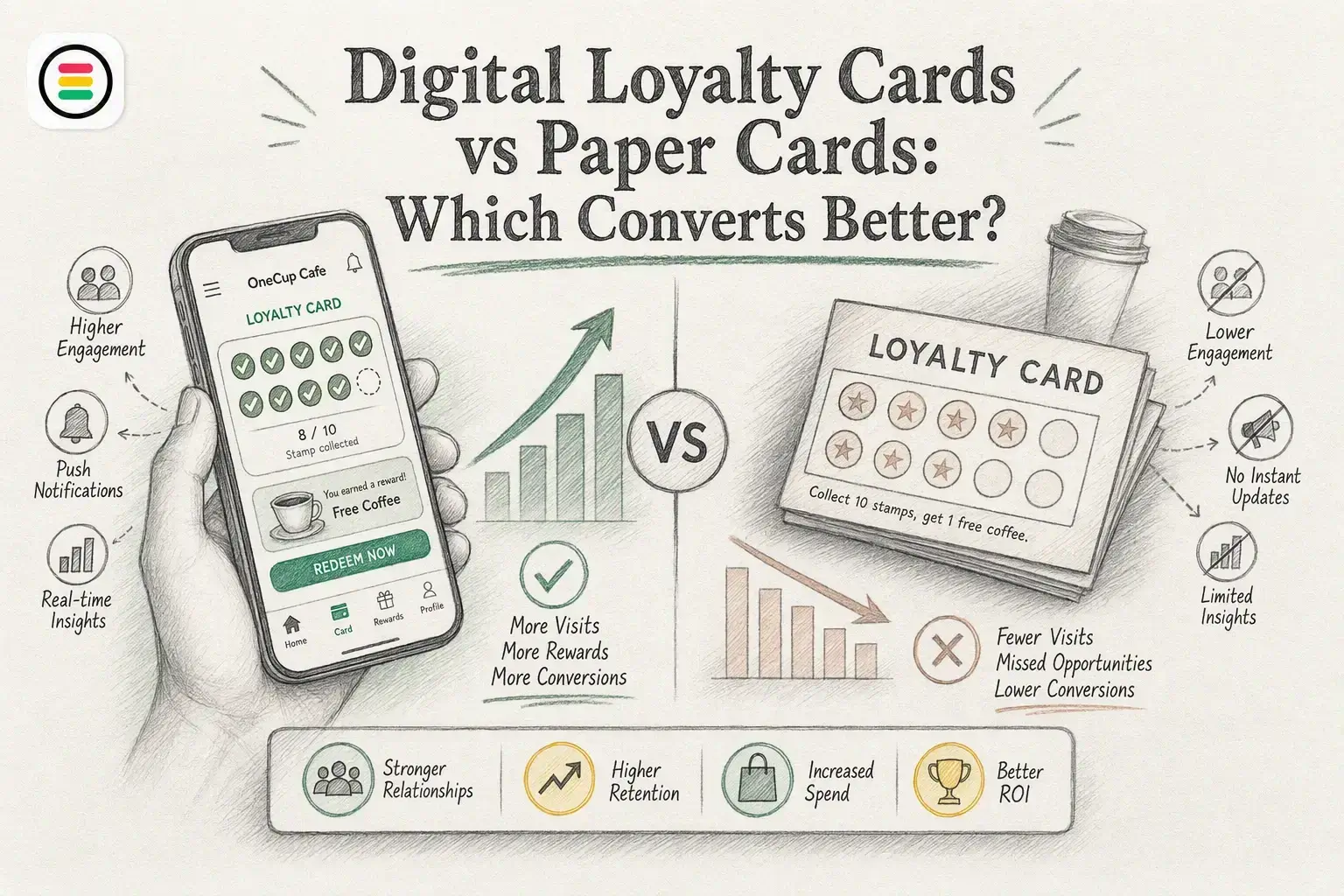
Quick Summary: Digital loyalty cards outperform paper ones by being more convenient, trackable, and able to send automated reminders, leading to higher conversion rates. Paper cards work best for quick, simple transactions but lack data and scalability. Small businesses should choose digital if they want measurable growth and better customer retention, while paper may suit very low-tech or short-term programs.
If you want more repeat visits and fewer lost cards, digital usually beats paper. Paper still works when you need the fastest, lowest-setup option. Small business owners need a loyalty system comparison customers use, staff can run, and managers can track. This loyalty system comparison reviews real use, fraud, effort, and results. Our loyalty system comparison focuses on what drives conversions.
| Digital loyalty cards | Paper loyalty cards | |
|---|---|---|
| Setup effort | Moderate, usually fast | Very low |
| Customer convenience | Very high | Basic and familiar |
| Tracking and data | Strong analytics and customer history | Minimal to none |
| Redemption follow-up | Automated reminders and notifications | Manual only |
| Fraud and loss risk | Low | Higher |
| Best fit | Local businesses wanting measurable repeat visits | Ultra-simple, low-tech, or temporary programs |
Digital loyalty cards live on a customer's phone and track visits or rewards automatically. They fit local businesses that want easy repeat visits, better follow-up, and clear data on who comes back.
 Key strengths
Paper loyalty cards are physical stamp or punch cards handed out in store. They suit ultra-simple, low-tech, or short-term programs where setup speed matters more than tracking. Key strengths
Digital loyalty cards convert better because people keep their phones close and check them all day. A paper card gets lost, bent, or left in another wallet. Mobile wallet use for non-payment items has risen sharply since 2019, according to ACI Worldwide’s 2025 report. That simple habit gap matters. If the reward is easy to find at checkout, more customers use it and come back.
Digital cards also win because they can remind people to act. Paper cards stay silent. Digital programs can send timely updates, reward progress, and nudge the next visit. A 2025 field experiment found that mobile push increased coupon redemption by 6.0%. That is a direct conversion edge for local businesses.
Also Read: Loyalty Reward Cards: How They Work and Why Your Business Needs One
The charm of instant understanding
Paper cards still work when speed beats tracking. A customer gets it in one second: buy, stamp, repeat. That matters in busy cafes, pop-ups, and older-skewing shops. EY found consumers want loyalty value to feel clear and easy to see in the moment, not buried in rules or screens (EY Loyalty Market Study).

The limits that cap conversion
Paper starts fast, but it rarely scales well. You cannot track drop-off, send reminders, or recover lost cards. A 2026 study of 23,296 stamps found completion falls hard when rewards take too long, so weak card design hurts paper fast (23,000-stamp study).
Also Read: Wallet Passes vs. Standalone Loyalty Apps: Which Is Better?
Match the format to your traffic pattern. Fast-repeat shops like cafes, bakeries, and car washes often win with simple digital stamp cards. Low-frequency businesses may need points, reminders, or wallet passes. Google Wallet highlights loyalty passes and timely notifications that help bring customers back.

Look at staff time, not just sticker price. Paper looks cheap until staff replace lost cards, answer reward disputes, and count punches by hand. Research on mobile loyalty found app adoption increased purchases and reward redemption, but setup should still fit your team’s workflow, per this study.
Choose the system customers will actually finish. If rewards feel hard to track, people quit. Pick the option with the fewest steps.
Also Read: Loyalty Program Cards: The Complete Guide for Businesses
Choose digital if you want growth you can measure. Digital cards show active members, repeat visits, reward use, and drop-off points. That matters because loyalty leaders now judge success by retention, lifetime value, and ROI, according to the Open Loyalty benchmark report.
Choose paper only if your program is intentionally lightweight. Paper fits pop-ups, cash-first shops, or very low-volume stores. Still, it gives you almost no tracking, and EY's 2026 loyalty study shows brands increasingly need simpler, visible value customers can use fast.
Ready to replace paper cards? Try OneCup to launch app-free digital loyalty cards that track results, cut loss, and help more customers come back.
Choose digital if you want better tracking, faster repeat visits, and easier multi-location control. Choose paper only if your customers avoid smartphones or your setup must stay very simple.
Up front, yes. Long term, they often waste less money because you can track redemptions, stop fraud, and send offers that bring customers back.
They can work for low-cost, walk-in businesses. But they get lost, copied, and give you almost no customer data to improve results.
Digital loyalty cards usually convert better because they cut friction, track behavior, and make rewards easier to use. EY found customers want simpler value, while Antavo reported friction kills reward use.
OneCup LLC
651 N BROAD ST - SUITE 201
MIDDLETOWN DE 19709
United States
Whatsapp : +18023003737

.svg)

.svg)