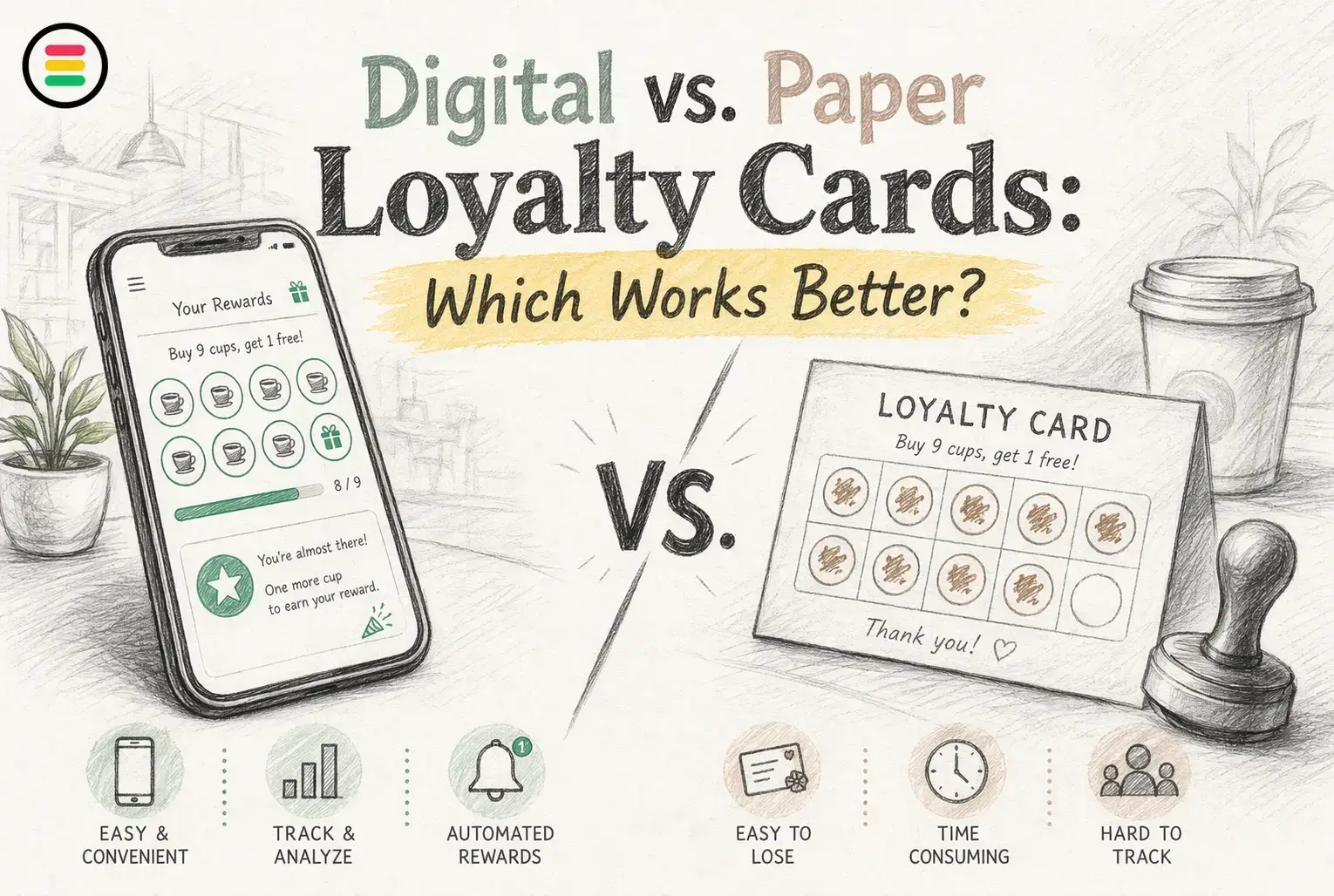
Quick Summary: Digital loyalty programs outperform paper cards by offering better tracking, easier re-engagement, and scalability across multiple locations. They reduce administrative work and provide valuable customer data for personalized marketing. Paper cards are simpler and cheaper upfront but lack long-term growth potential and detailed insights. For most businesses aiming to grow and improve retention, digital loyalty solutions like OneCup are the smarter choice.
Most businesses get more value from Digital Loyalty Programs than Paper Loyalty Cards. You track visits better, re-engage past buyers faster, and scale across locations with less mess. Still, Paper Loyalty Cards can work for very simple, low-cost setups.
This Loyalty Card Comparison looks at the trade-offs owners face every day: cost, setup time, customer ease, and tracking repeat visits across one store or many. A smart Reward Program Comparison should cover real workflow issues, not just features.
We work from the business side of retention, operations, and customer data. This Loyalty Card Comparison breaks down Loyalty Card Benefits, Loyalty Platform Features, App-Free Loyalty Systems, and Scalable Loyalty Solutions so you can choose the right Customer Loyalty Solutions. This Loyalty Card Comparison shows whether Digital Loyalty Programs or Paper Loyalty Cards fit better.
| Digital loyalty cards | Paper loyalty cards | |
|---|---|---|
| Setup speed | Fast; often live in minutes or days | Instant; print and hand out |
| Customer friction | Low; card can live on phone, often no app | Very low; no device or account needed |
| Tracking and data | Strong; visit and reward data can be measured | Minimal; little customer insight |
| Scalability | High; easier for multi-location use | Limited; harder to manage across locations |
| Cost efficiency | Usually better at scale; less printing and manual admin | Low upfront, but recurring print and replacement costs |
| Best for | Businesses that want retention, data, and easy re-engagement | Very small, low-volume businesses wanting maximum simplicity |
Digital loyalty cards put rewards on the customer's phone and give businesses clear tracking, messaging, and follow-up tools. They fit brands that want Digital Loyalty Programs with low friction, better repeat-visit data, and room to grow across locations.
 Key strengths
Paper loyalty cards use stamps or punches to reward repeat visits with almost no setup. They suit very small businesses that want a simple offline option, though loyalty program research shows program design still shapes results.
Paper and digital do not feel different just because one is printed and one lives on a phone. The real gap is in speed, memory, and visibility. A paper card is easy to hand out, but customers must keep it, bring it back, and trust staff to stamp it right. Digital removes that pocket friction and makes progress easier to see. That matters because loyalty works better when rewards feel simple and close. Deloitte found that 72% of consumers say loyalty programs make them more likely to spend with their preferred brand, and it also notes that effortless redemption lifts engagement according to Deloitte.
Customers stay engaged when earning and redeeming rewards feels quick, obvious, and low-stress.
No-app access matters most in busy local businesses like cafes, takeaways, salons, and bars. People in line do not want to download, register, confirm email, and then find a login. Fast Company reports that 87% of patrons want loyalty programs to be simple to understand and use in its 2026 loyalty article. That is why app-free digital cards often beat both paper cards and app-based systems.
For brands like OneCup, that middle ground is the key win.
Paper cards win on startup cost. You can print a batch fast and train staff in minutes. That makes them feel like the low-risk option.
The hidden costs show up later:
A paper system also gives you almost no visibility. If redemptions spike, you cannot tell whether the offer worked or the process leaked. That admin gap matters because ease of management is now the top valued feature for loyalty teams, according to Antavo's 2026 loyalty report.
| Cost area | Paper card impact | Why it adds up |
|---|---|---|
| Printing | Small but recurring | Ongoing reorders |
| Fraud | Hard to control | Manual validation |
| Reporting | Nearly none | More guesswork |
| Staff time | Manual checks | Slower service |

Digital costs more each month, but it usually cuts daily workload.
Staff do fewer manual tasks:
That matters in busy stores, cafes, and multi-site groups. Open Loyalty's 2026 research says 75% of businesses prioritize real-time rewards, which only work well when tracking is automatic and fast Open Loyalty's 2026 trends report.
For operators, the best savings are often in consistency:
If your team is already stretched, the cheapest system on paper may be the most expensive to run.
Digital loyalty turns every visit into usable customer data. You can see who came back, what they bought, how often they visit, and which offer drove the sale. Paper cards cannot do that at scale.
That matters because loyalty data feeds better targeting. According to Bloomreach's 2026 loyalty research summary, nearly 9 in 10 program owners who measure performance report positive ROI, and loyalty data helps power personalization and AI readiness.
| Capability | Digital card | Paper card |
|---|---|---|
| Customer identification | Yes | No |
| Personal offers | Yes | No |
| Cross-location tracking | Yes | Rarely |
| Campaign reporting | Yes | No |

If you run more than one location, digital usually wins fast because your data stays in one system.
Paper still works when your goal is basic and local. A cafe, car wash, or takeaway shop may only need a simple "buy 9, get 1 free" offer. Staff can explain it in one sentence, and customers do not need a phone number or inbox.
That low friction matters, especially for:
Still, paper has a ceiling. You cannot build audience lists, test campaigns, or learn much beyond rough redemption volume. And broad, non-personalized outreach performs worse. The 2026 US Engagement Index found many consumers think most marketing emails are not relevant.
Paper is fine for simple stamp rewards. Digital is better if you want retention plus real marketing reach.
Paper loyalty cards work fine in one shop. They start to fail when customers visit more than one site. Staff cannot see stamps, balances, or reward history from another location, so the experience turns patchy. Talon.One notes that multi-location loyalty needs one shared database and unified rules so customers can earn in one place and redeem in another without friction in its franchise loyalty guide.
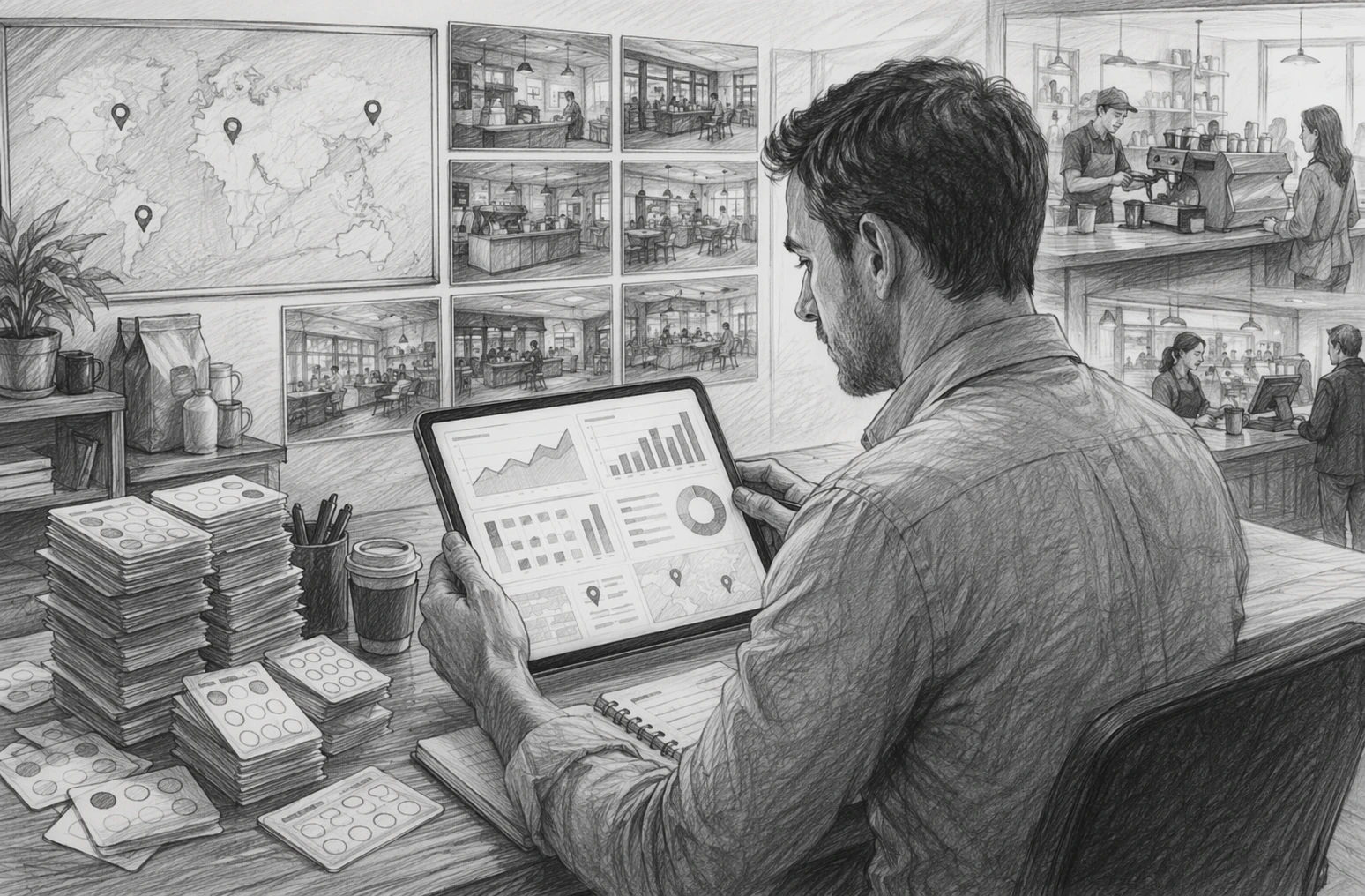
Digital scales better because HQ can control rules while each site still runs local offers. That matters once you have several stores, mixed POS setups, or online and offline sales. Vontier's Unified Payments Research 2026 found 68% of surveyed retailers operate two or more payment systems, which shows how fast complexity grows.
| Business type | Better fit |
|---|---|
| Single-site cafe | Paper or simple digital |
| 2-5 locations | Digital usually wins |
| Franchise or chain | Digital strongly preferred |
If you want clean reporting, cross-location rewards, and easier rollout, digital is the safer long-term choice. Platforms like OneCup fit this stage well because they stay app-free while scaling across locations.
Choose paper cards if speed and low setup matter more than data. They work best for one-site cafes, market stalls, car washes, and other simple repeat-visit businesses. Staff can explain them in seconds. Customers already know how they work.
Pick paper only if you can accept lost cards, weak tracking, and almost no remarketing after the visit.
Choose digital cards if you want stronger retention, clearer reporting, and easier scaling. Deloitte found 72% of consumers say loyalty programs make them more likely to spend with their preferred brand, and 56% increase spending because of the program, according to Deloitte's loyalty survey. Digital also helps when you run multiple locations, need offer control, or want to see which rewards actually drive repeat visits.
Choose app-free digital loyalty when you want the gains of digital without the friction of asking people to download another app. That middle ground fits restaurants, salons, clinics, and local chains well. BCG notes the average U.S. consumer now belongs to more than 15 programs, which means attention is crowded, per BCG's loyalty research. A tool like OneCup makes the choice easier if you want simple signup, better visibility, and less customer drop-off.
Digital cards are harder to lose, easier to track, and faster to update. They cut print costs, show customer data, and work better across multiple locations than paper cards.
Digital cards let you send reminders, reward updates, and timed offers. Paper cards cannot do that, so customers forget faster and visit less often between purchases.
Usually, yes. Paper looks cheap at first, but reprints, fraud, and manual tracking add cost. Digital systems save time and scale better as your customer base grows.
Look for app-free access, easy setup, customer data, multi-store support, reward rules, branding options, and simple staff use. Good reporting matters if you want steady improvement.
OneCup helps brands run app-free loyalty across regions with simple sign-up, branded rewards, and smoother repeat visits. That lowers friction and makes it easier to keep customers active.
The main issues are staff training, customer habits, and data setup. Some buyers still prefer paper, so a short mixed period often helps reduce confusion and pushback.
Digital programs keep your brand in front of customers through mobile wallets and repeat touchpoints. That creates more recall than paper, especially for chains and tourist-heavy markets.
Often yes, but it depends on the platform. Check POS links, CRM support, reporting exports, and location controls first. Strong integration reduces manual work and keeps data cleaner.
Digital loyalty cards win for most growing businesses because they cut customer friction, track behavior, and scale across locations. Paper cards still fit simple setups like pop-ups, cash-heavy shops, or older customer bases. The real choice is not trend versus tradition. It is ease, control, and growth. EY found that digital-first convenience now shapes loyalty expectations, with more than half of surveyed customers frequently using mobile apps for loyalty according to EY's 2025 study. > If you need data and repeatable retention, digital is usually the better long-term bet.
If you're ready to make the switch from paper to digital, OneCup offers app-free digital loyalty cards that are simple to launch and easy for customers to use. Get started with OneCup and see how simple digital loyalty can be.
OneCup LLC
651 N BROAD ST - SUITE 201
MIDDLETOWN DE 19709
United States
Whatsapp : +18023003737

.svg)

.svg)