
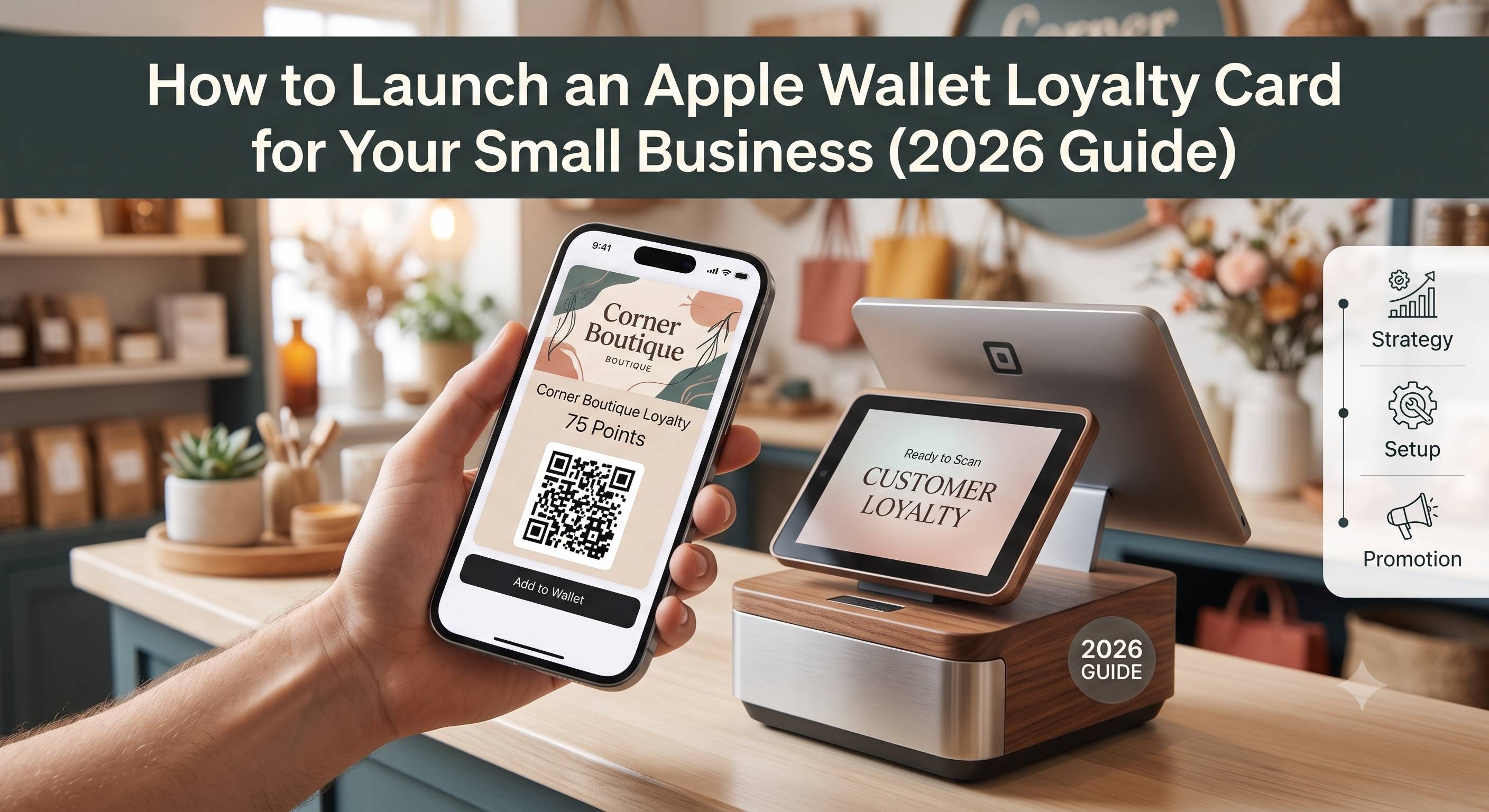
Your regulars already carry their bank cards, boarding passes and event tickets in Apple Wallet. The question is why your loyalty card isn't sitting there too — especially now that setting one up takes an afternoon, not a development budget.
For years, wallet-based loyalty was treated as a big-brand tool. Coffee chains and airlines had it; the independent café down the road didn't. That gap has closed. Today, any small business — a salon, a barbershop, a bakery, a car wash — can issue a professional Apple Wallet loyalty card using an off-the-shelf platform, with no code and no IT support.
This guide walks through what an Apple Wallet loyalty card actually is, why customers adopt digital loyalty cards at rates paper cards and branded apps never reach, what it realistically costs, and how to launch one properly — including the mistakes that quietly sink most first attempts.
- A digital loyalty card is a branded pass stored in Apple Wallet or Google Wallet that tracks a customer's stamps or points in real time — no app download required.
- Customers join by scanning a QR code and tapping "Add to Wallet", which takes about ten seconds and drives far higher enrolment than paper punch cards or branded apps.
- Wallet cards give small businesses lock-screen push notifications, visit analytics, and automated win-back campaigns at the cost of a modest monthly subscription.
- Platforms such as OneCup let cafés, salons, barbershops and other local businesses launch a digital stamp card in under an hour, with no coding.
What Is an Apple Wallet Loyalty Card?
An Apple Wallet loyalty card is a digital loyalty card stored in the Wallet app on an iPhone that tracks a customer's stamps, points or rewards in real time, replacing the traditional paper punch card. Apple Wallet is pre-installed on every iPhone and already holds people's bank cards, boarding passes and tickets — your branded loyalty pass simply joins that stack.
Instead of handing out a paper card to be punched (and eventually lost), you display a QR code at your counter or on your social profiles. A customer scans it with their phone camera, taps Add to Apple Wallet, and your card appears alongside their payment cards. From then on:
- Their stamp or point balance updates instantly every time they visit
- The card is reachable from the lock screen, with no app to open
- You can send lock-screen notifications tied to the card
- The card can't be forgotten at home, damaged or thrown away
Behind the scenes, a loyalty platform generates and maintains the pass. Apple defined the underlying technology (called PassKit) over a decade ago; what's new is that small-business software has made it accessible without touching a line of code.
Digital Loyalty Cards vs Paper Punch Cards vs Branded Apps
Loyalty programs live or die on one variable: friction. Every extra step between "customer hears about your program" and "customer is enrolled and using it" cuts participation dramatically. Compare the three common approaches:
| Paper stamp card | Branded app | Apple Wallet card | |
|---|---|---|---|
| Sign-up effort | Low, but cards get lost | High — download, account, password | One scan, one tap |
| Typical enrolment | Moderate, high drop-off | Low — most customers decline | High — minimal friction |
| Can you contact members? | No | Yes, if notifications allowed | Yes — lock-screen push included |
| Data & analytics | None | Full | Full |
| Ongoing cost | Printing, forever | Very high (build + maintain) | Modest monthly subscription |
The branded-app route fails for small businesses not because apps are bad, but because customers ration the apps they'll install. Nobody downloads a dedicated app for the sandwich shop they visit twice a month. A wallet pass sidesteps that resistance entirely: there's nothing to install, because the "app" is already on every iPhone.
Five Practical Benefits You'll Notice First
1. Your brand appears on their phone every day
Every time a customer opens their wallet to pay for something, your card is visible in the stack. That passive exposure — dozens of impressions per week, at zero cost — is something no paper card or email list can replicate, and it keeps your business in mind between visits.
2. Lock-screen messaging that actually gets seen
Emails land in crowded inboxes; SMS costs per message. Wallet notifications appear directly on the lock screen and cost nothing extra on most platforms. Used sparingly — a reward-progress nudge, a birthday treat, a rainy-Tuesday offer — they're among the highest-response marketing channels a local business can access.
3. The "I lost my card" conversation disappears
Anyone who has run a punch-card scheme knows the awkward moment: a customer swears they had eight stamps on the card they can't find. Digital cards end the dispute permanently. The balance lives on their phone and in your dashboard, and both always agree.
4. You finally get data
Paper cards tell you nothing. A wallet-based program shows you how many active members you have, how often they visit, which rewards get redeemed, and who has gone quiet — the exact information you need to run targeted win-back campaigns instead of guessing.
5. Slow periods become fixable
When you can message your whole member base (or a segment of it) in seconds, a dead Wednesday afternoon becomes a solvable problem: send a time-limited offer and watch a portion of nearby members respond the same day.
Setting One Up: The Realistic Step-by-Step
Here's what launching actually looks like for a typical independent business. Total hands-on time is usually under two hours, spread across a week or two.
- Pick a digital loyalty card platform (30–45 minutes of research). Shortlist tools — such as OneCup — that offer genuine Apple Wallet and Google Wallet passes, transparent monthly pricing, a free trial, unlimited push notifications, and — critically — the ability to export your customer data if you ever leave. If a platform won't confirm data export, walk away.
- Design your card (30 minutes). Upload your logo, match your brand colours, and write one clear line describing the reward. Resist complexity: a simple structure like "collect 8 stamps, get a free item" or "1 point per £1, £5 off at 50 points" converts better than clever tiered schemes at launch.
- Choose a reward customers actually want (15 minutes of honest thinking). The reward should be desirable enough to change behaviour but affordable at your margins. A free coffee after eight paid ones costs you pence; a percentage off a large service booking may not. Model the worst case before you commit.
- Print and place your QR code (same day). Counter tent card, till sticker, window decal, receipt footer, Instagram bio link, Google Business profile. The QR code should be visible at the exact moment a customer is waiting with their phone out.
- Brief your team (10 minutes). Staff need two skills: scanning a customer's card to add a stamp, and a one-line invitation — "Have you grabbed our digital loyalty card? It takes about ten seconds." That sentence, said consistently, is the single biggest driver of enrolment.
- Send a welcome campaign (week two). Once you have your first wave of members, send one message — a thank-you with a small time-limited perk. It confirms the channel works and trains members to notice your notifications.
- Switch on automations (weeks three to four). Birthday rewards, "you're one stamp away" nudges, and a re-engagement message for anyone inactive for 6–8 weeks. Set these once and they run themselves.
What It Costs (and What It Returns)
Expect to pay a monthly software subscription roughly comparable to what many businesses already spend printing paper loyalty cards each year — except the digital version comes with messaging, analytics and automation built in. There's no hardware to buy: staff scan cards with the phone or tablet you already own.
The return comes from three places:
- Visit frequency. Members with visible progress toward a reward come back sooner. Even a modest lift — one extra visit per member per month — compounds quickly across a member base of a few hundred people.
- Recovered lapsed customers. Without a program, a customer who drifts away is simply gone. With one, an automated win-back message recovers a meaningful slice of them at no marginal cost.
- Owned marketing channel. Every member is someone you can reach directly, forever, without paying a social platform for the privilege. That alone changes the economics of promoting a new product, a seasonal menu or a quiet-day offer.
A sensible way to judge it: estimate your average transaction value, multiply by the number of extra visits you'd need per month to cover the subscription, and you'll usually find the break-even point is a handful of visits — a low bar for any business with regular footfall.
Four Mistakes That Sink First-Time Programs
Making the reward too distant
Twenty stamps for a free item feels like a mountain; most customers give up mentally before they start. Keep the first reward reachable within a realistic month of normal visiting, and consider giving one "head start" stamp at sign-up — progress that's already begun is far more motivating than a blank card.
Launching quietly
A QR code taped to the till, never mentioned, will enrol almost nobody. Enrolment is a habit your team builds: mention the card at every checkout for the first month, and sign-ups follow.
Over-messaging (or never messaging)
Push notifications are powerful precisely because they're rare. Two to four messages a month — each with a genuine reason to visit — keeps the channel welcome. Zero messages wastes the program's biggest advantage; daily messages gets your card deleted.
Ignoring the dashboard
The analytics aren't decoration. Ten minutes a week reviewing who's close to a reward and who's gone quiet turns raw data into targeted, high-conversion messages. Businesses that skip this step run a stamp card; businesses that do it run a retention engine.
Is It Right for Your Business?
A digital loyalty card suits any business built on repeat visits: a loyalty program for cafés and coffee shops, a digital stamp card for hair and beauty salons or barbershops, QR code loyalty for takeaways and restaurants, and points-based rewards for car washes, groomers, gyms, studios and independent retail. If your customers could plausibly visit weekly or monthly, the format fits.
It's a weaker match for genuinely one-off purchases — although even there, referral rewards and gift-card passes can make the wallet channel earn its keep.
Frequently Asked Questions
Do I need a developer to create an Apple Wallet loyalty card?
No. Loyalty platforms built for small businesses provide visual card builders that generate the wallet pass for you. If you can set up a social media profile, you can set up a wallet loyalty card.
How do customers add the card?
They point their phone camera at your QR code and tap "Add to Apple Wallet". No app download, no account creation, no password. The whole process takes around ten seconds, which is exactly why adoption is so much higher than app-based programs.
What happens for Android users?
The same QR code issues a Google Wallet pass to Android phones automatically. You manage one program; the platform handles both wallet ecosystems.
Can customers use the card if they don't have their phone?
Yes — good platforms let staff look up a member by phone number and apply the stamp manually. The card updates the next time the customer opens their wallet.
Am I locked into one platform forever?
You shouldn't be. Before signing up, confirm the platform lets you export your member list and balances. Your customer relationships belong to you, not your software vendor.
What is the easiest way to create a digital loyalty card?
Use a no-code digital loyalty card platform like OneCup: design your card in a visual builder, print the generated QR code, and customers add the pass to Apple Wallet or Google Wallet in one tap. Most businesses go from sign-up to a live loyalty program in under an hour.
Ready to put your loyalty card in your customers' pockets?
With OneCup, you can design and launch a digital loyalty card for Apple Wallet and Google Wallet in under an hour — no coding, no contracts. Create your card free at onecup.cc.

.svg)

.svg)